Know the money
Charge the right price for every season
Set your rates once a year. MangoHost applies them every night after that.
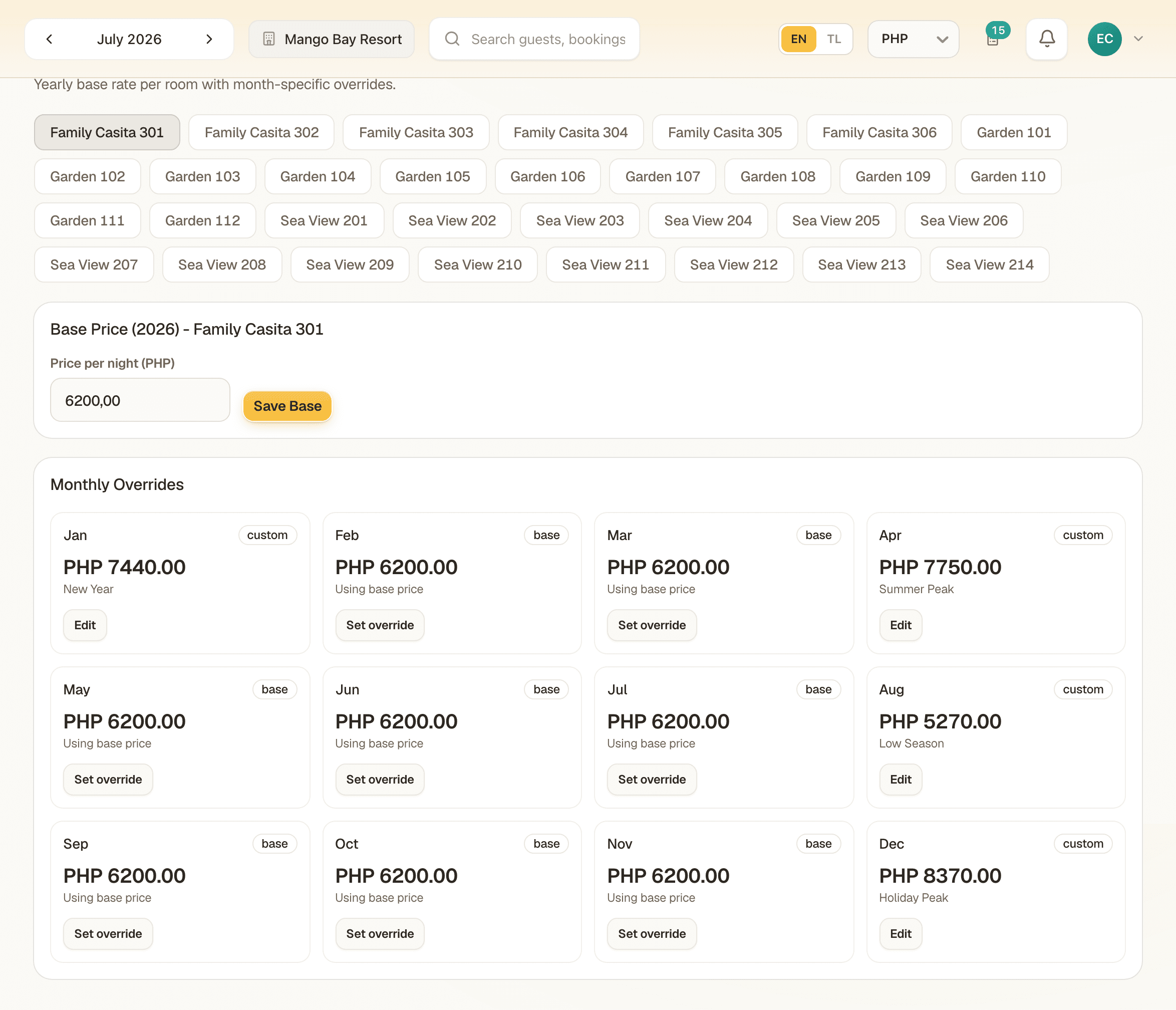
Rates live in someone's head, and that person is not always at the desk. Holy Week gets charged at January prices because whoever took the booking did not know. A quiet September gets charged at peak because nobody remembered to bring it down.
Over a year, that is not a rounding error. It is the difference between a good season and an average one, and it never shows up as a single obvious mistake.
Seasonal pricing is one of the modules included in the MangoHost platform — every plan has all of them, so nothing on this page is an upsell.
The workflow
How it works
A base rate, then the exceptions
Each room gets a base price for the year. That is the rate that applies unless you say otherwise, which is how most nights are actually priced.
Then you override the months that are different. Twelve cells per room, per year, and you fill in only the ones that matter.
Name your seasons
An override carries a label — "Holy Week", "Summer Peak", "Low Season" — so the grid reads as your pricing strategy rather than a wall of numbers. Six months later you can see not just what you charged but why.
Remove an override and the month falls back to the base rate. Nothing is left half-configured.
The rate reaches the money
Pricing is not a separate document. The rate you set is the rate a booking is priced at, and the same figure flows into your average daily rate, your RevPAR and your profit. Change a season and the analytics follow.
The resolution is deliberately boring, which is what you want from pricing: for any night, MangoHost looks for an override on that month for that room, and uses the base rate if there is not one. There is no third rule, no hidden precedence, and no state where a night has no price.
Planned once, applied by whoever is on the desk
The point of setting rates in the system rather than agreeing them in a meeting is that the person taking a booking at nine on a Sunday evening does not have to know your pricing strategy — or call you to ask.
Next year can be built while this year is running, on its own grid, without touching live rates.
Sell more than the room
Airport transfers, a dive trip, breakfast, a late checkout. Optional services can be priced per person, per night, or both, and resolve as line items on the booking — so what a guest actually spent is on their reservation rather than in a side conversation.
Worth knowing
This is seasonal pricing, not a demand algorithm
MangoHost does not watch your competitors or your pickup curve and move your rates for you. You set the strategy; MangoHost applies it every night without fail. For a property where the owner knows the seasons better than any model would, that is usually the right trade — but if you are shopping for automated revenue management, this is not that, and we would rather you knew now.
In detail
| Yearly base rate per room | The default for every night. |
|---|---|
| Month-specific overrides | A twelve-cell grid per room, per year. |
| Named seasons | Each override carries a label. |
| Fall back to base | Remove an override and the base rate resumes. |
| Year navigation | Plan next year without disturbing this one. |
| Feeds the revenue maths | The effective price resolves base, then override. |
| Optional services | Per-person and per-night extras as booking line items. |
Who this is for
Your rates change with the season, not with the hour
Philippine dry season, Holy Week, the local fiesta. Monthly overrides match how the demand actually moves.
More than one person takes bookings
Once the rate is in the system, nobody has to remember it — or ask.
See it on your own property
Thirty minutes with the IslandLink team, your rooms and your rates. No card, nothing to sign.