Run the day
Everyone knows which rooms are ready
A live room board your housekeepers actually use, with a real inspection step.
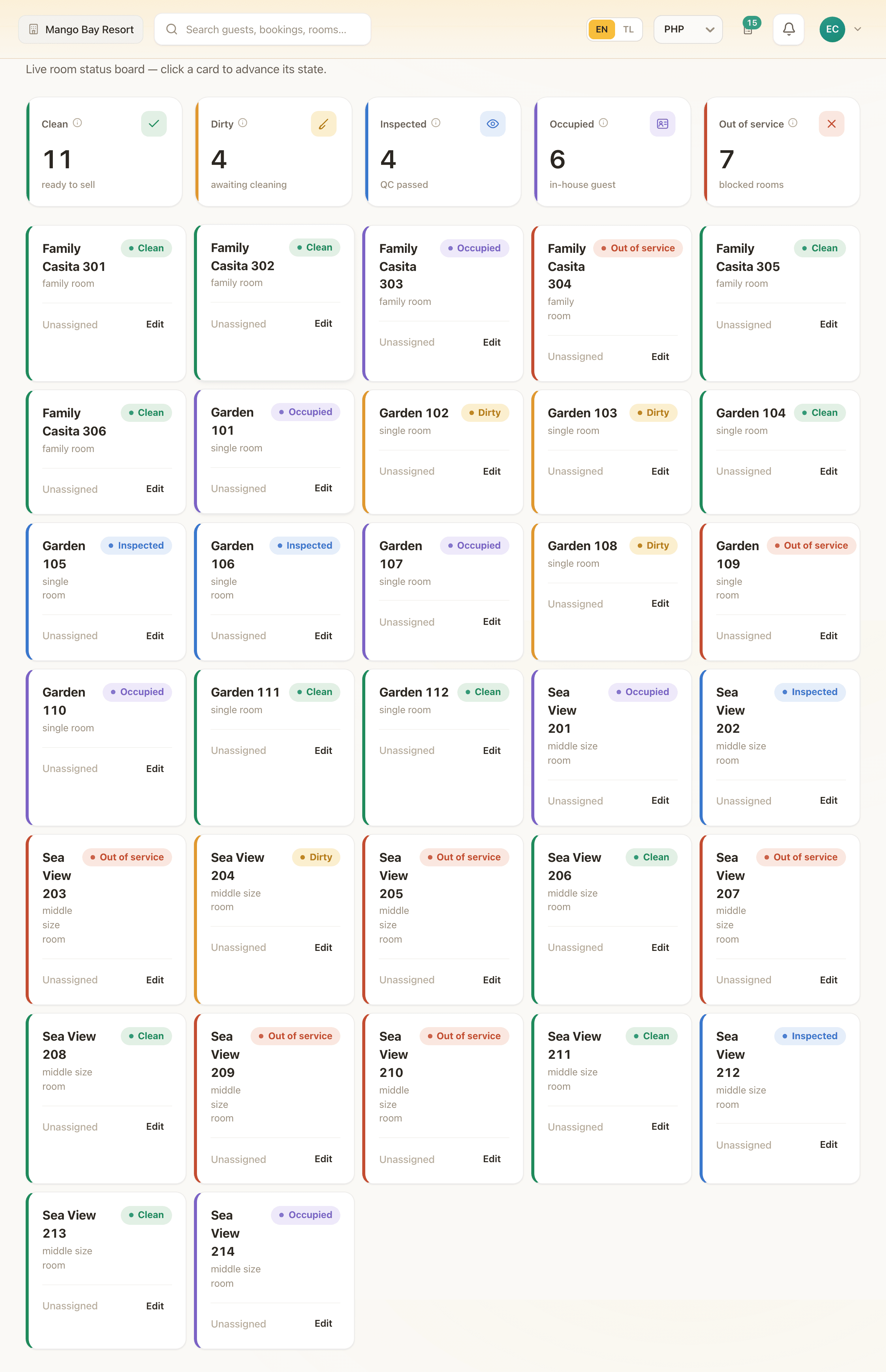
Departures are known at the front desk. Cleaning happens on another floor. The room that was ready an hour ago is still marked dirty on someone's list, so an early arrival waits in the lobby for a room that is sitting empty and clean.
The reverse is worse: a room gets sold as ready because nobody checked, and the guest walks into yesterday's towels.
Housekeeping is one of the modules included in the MangoHost platform — every plan has all of them, so nothing on this page is an upsell.
The workflow
How it works
Five states, not two
Clean means ready to sell. Dirty means awaiting cleaning. Occupied means there is a guest in it. Out of service means blocked, and it stays out of your sellable inventory.
And between dirty and clean there is Inspected — the room has been done and someone has checked it. Most tools at this price have clean and dirty only, which quietly puts the supervisor's judgement nowhere.
One tap to move it along
Tap a room card and it advances to the next state. A housekeeper on a phone in a corridor can update ten rooms in half a minute without opening a form.
Each room can also carry an assignee, the current guest's name, and a note — "extra towels", "guest asked for a late clean".
In the language your staff speak
The whole interface is available in Tagalog as well as English. This is the answer to the objection that decides most of these purchases — my staff will not use it. They will use it if it is in their language and takes one tap.
The rest of the day, assigned
A room board answers which rooms. It does not answer the pool chemicals, the beach frontage, the minibars on the second floor, or who is chasing the supplier invoice. Those live as daily tasks, assigned per person, with a priority and a category.
Recurring routines are entered once and appear every day. One-off jobs go in as they come up. What each person is responsible for today is a list with their name on it rather than a conversation they may have half-remembered.
Supplies count themselves
Welcome kits, toiletries and linen can be linked to a check-in, so stock comes down as guests arrive instead of at a monthly count that nobody trusts. It is the difference between knowing you are short and finding out.
The board catches up on its own
A check-in made outside this app, a room assigned after the fact, or a unit that never had a housekeeping row can otherwise leave a room showing Clean with a guest already in it — which is exactly the mistake the board exists to prevent, in either direction: walking into an occupied room, or skipping a dirty one. Opening the board reconciles it first, silently, against every checked-in booking — no cron, no worker, nothing to configure.
In detail
| Five-state board | Clean, dirty, inspected, occupied, out of service. |
|---|---|
| One-tap advance | Cycle a room to its next state. |
| Direct set | Jump straight to any state when the sequence does not fit. |
| Assignee per room | Who is responsible for this one. |
| Current guest | Surfaced on the card, including a VIP flag. |
| Free-text note | Per room, per day. |
| Tagalog interface | The whole app, not just this screen. |
| Per-module staff access | A housekeeper can be given this board and nothing else. |
| Stock deduction on check-in | Consumables come off inventory automatically. |
| Self-reconciling board | Occupied status auto-corrects against checked-in bookings on load, even for check-ins made outside this app. |
Who this is for
Your housekeepers do not sit at a desk
The board is built for a phone held in one hand in a corridor, which is where the update actually happens.
You have had a room sold before it was checked
The Inspected state exists so that "cleaned" and "approved to sell" are not the same claim.
See it on your own property
Thirty minutes with the IslandLink team, your rooms and your rates. No card, nothing to sign.