Know the money
Stock that counts itself
On-hand is a ledger, not a guess — and welcome kits come off as guests check in.
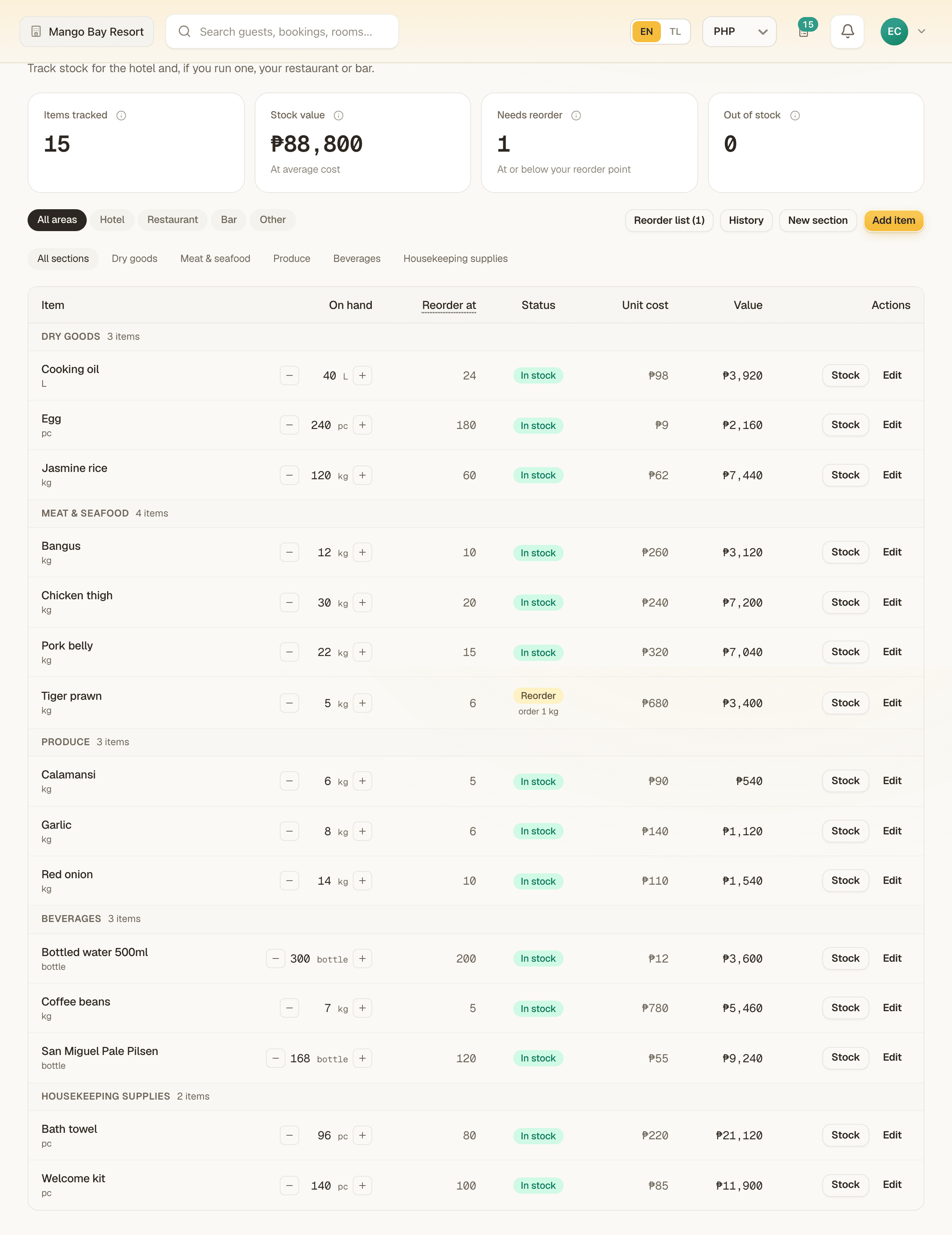
Most small hotels find out they are short of something at the moment they need it. Towels before a full house, gas before a breakfast service, beer before a long weekend. In between, nobody knows the number — there is a count someone did last month and a general feeling.
The other half of the problem is quieter. Without a number you cannot tell shrinkage from consumption, so anything that goes missing looks exactly like something that got used.
Stock & inventory is one of the modules included in the MangoHost platform — every plan has all of them, so nothing on this page is an upsell.
The workflow
How it works
A ledger, not a number someone overwrote
Every change to stock is a movement with its own row: a purchase, usage, waste, an adjustment, or a physical count. On-hand is what the movements add up to, and the balance after each one is stored alongside it.
Nothing is edited and nothing is deleted. A correction is a new compensating entry, which means the history of an item is the whole history — and a discrepancy has a date and a person attached rather than being absorbed silently.
Organised the way your store actually is
Categories carry an area — hotel, restaurant, bar or other — so the housekeeping store and the kitchen store are separate lists rather than one long alphabetical scroll.
Each item holds its stock unit, its purchase unit and how many stock units come in one purchase unit. You buy oil by the case and use it by the litre; the system does that conversion so nobody is doing it on a calculator.
Par levels, so you find out early
Set the level you never want to drop below and the item tells you when it does. That is the whole mechanism — no forecasting model, just the number you already know in your head, written down where the person doing the ordering can see it.
Items also carry a supplier and a storage location, which is what turns a low-stock warning into an order someone can actually place.
Consumables that deduct themselves
Mark an item as per-stay — welcome kits, soap, slippers — and it comes off stock automatically when a booking is created. No form, no daily tally.
If you run the Restaurant add-on, the same ledger is what recipes draw from: selling a dish takes its ingredients out at the moment the order is placed, and voiding the bill puts them back.
In detail
| Movement kinds | Purchase receipt, usage, waste, adjustment and physical count. |
|---|---|
| Append-only ledger | Balance after each movement stored; corrections are compensating entries. |
| Categories with an area | Hotel, restaurant, bar or other. |
| Stock and purchase units | With a conversion factor between them. |
| Unit cost and valuation | Per item, carried on movements. |
| Par levels | A floor per item, surfaced when breached. |
| Supplier and storage location | Per item. |
| Auto-deduct per stay | Consumables come off when a booking is created. |
| Recipe consumption | With the Restaurant add-on, dishes deplete ingredients. |
| Quantity adjustment | For a count that disagrees with the ledger, recorded as such. |
Who this is for
You have never known your linen count
This is the cheapest version of knowing: enter what you have once, and let arrivals and orders do the rest.
You suspect things are walking
You cannot investigate a feeling. A ledger with dates and people on it is what turns it into a question with an answer.
See it on your own property
Thirty minutes with the IslandLink team, your rooms and your rates. No card, nothing to sign.