Run the day
Nothing stays broken
Work orders on a board, by priority and trade, with an average time to close you can hold people to.
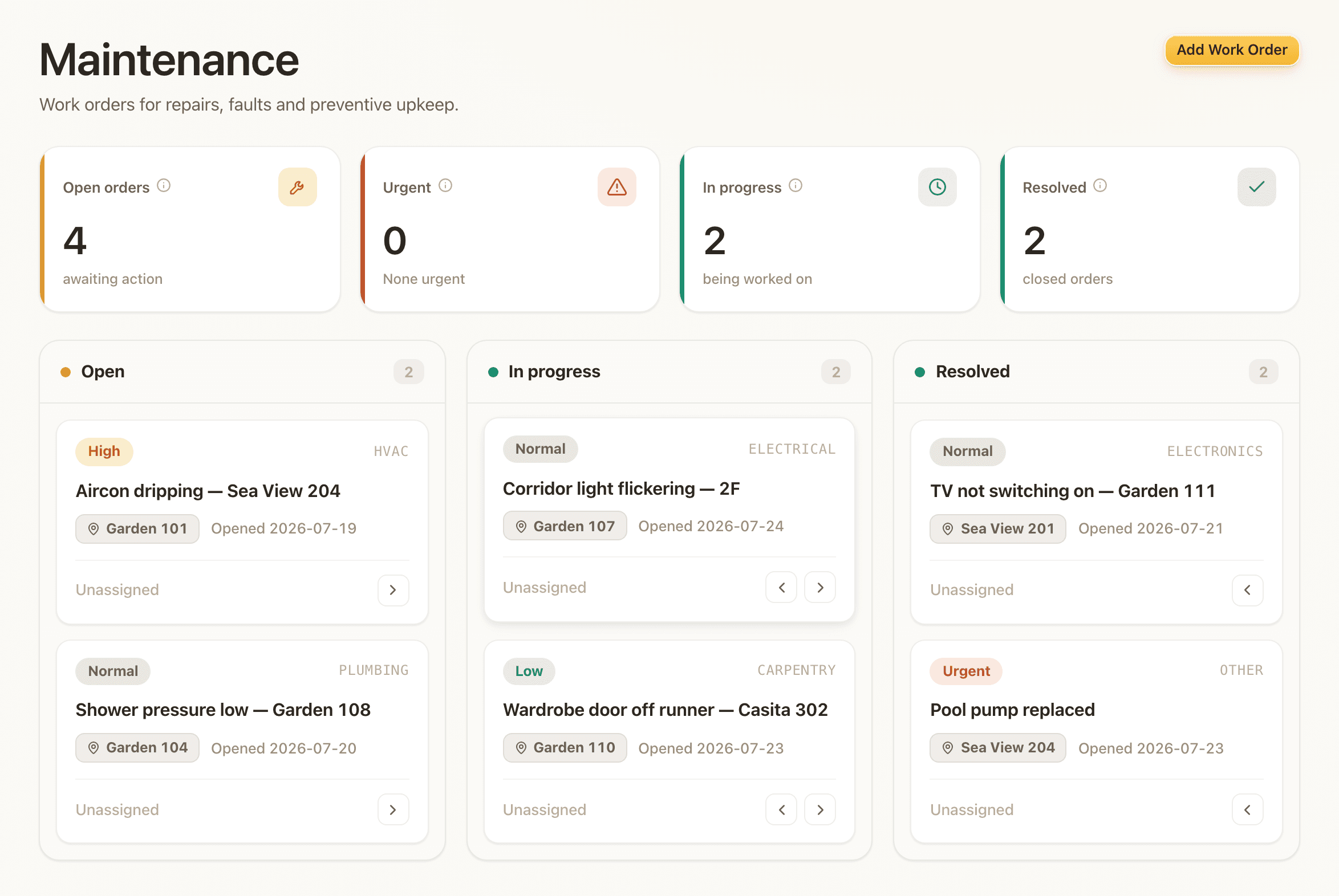
The aircon in 204 has been dripping for a week. Somebody mentioned it, somebody else meant to look at it, and the first person to find out it was never fixed is the guest who checks in tonight.
Small properties do not lose money on big repairs. They lose it on small ones that nobody owned.
Maintenance is one of the modules included in the MangoHost platform — every plan has all of them, so nothing on this page is an upsell.
The workflow
How it works
A board, so nothing sits invisibly
Open, in progress, resolved. A work order moves across as it gets worked, and the board is the whole status report — no one has to ask.
Each order carries a priority — urgent, high, normal or low — and urgent ones are surfaced separately, because a board where everything looks equally important is a list.
By trade, and by room
Categories match who you would actually call: plumbing, electrical, HVAC, carpentry, electronics, other. That is what lets you see that you have four electrical faults this month and one of them is the same socket.
An order can be attached to a room or to a common area, and it records who reported it and when it was opened.
The number that changes behaviour
Alongside open, urgent, in-progress and resolved counts sits average days to close. It is the only maintenance metric an owner can hold anyone to, and it is the one that gets the dripping aircon fixed.
Who reported it, and when it opened
Every order records the person who raised it and the date it was opened, and a resolved one records when it closed. That is what the average-days-to-close figure is computed from, rather than being a number someone estimates at a meeting.
It also settles the recurring argument about whether a fault was reported at all. It was, on the fourteenth, by Rosalie.
Attached to the room the guest will sleep in
An order can point at a room type or at a specific unit. That matters because the fault is in 204, not in "a Sea View double" — and because a room with an open urgent order is a room you may want to stop selling until it closes.
Common-area work — the pool pump, the generator, the beach steps — is held without a room rather than being forced into one.
Staff can report without seeing your numbers
Maintenance is a module, so it can be granted on its own. Give your maintenance lead this board and nothing else: they raise, work and close orders without ever seeing a rate, a payroll figure or a guest's contact details.
That is usually the difference between faults being logged and faults being mentioned in passing.
In detail
| Kanban board | Open, in progress, resolved. |
|---|---|
| Priority | Urgent, high, normal, low — with urgent surfaced. |
| Trade categories | Plumbing, electrical, HVAC, carpentry, electronics, other. |
| Room or common area | Linked to a specific room, a unit, or neither. |
| Reporter and dates | Who raised it, when it opened, when it resolved. |
| KPIs | Open, urgent, in progress, resolved, and average days to close. |
Who this is for
Faults reach you by conversation
A board is the smallest change that turns a mention into something with an owner and a date.
You want to know whether upkeep is working
Average days to close is the answer, and it is on the page rather than in a spreadsheet.
See it on your own property
Thirty minutes with the IslandLink team, your rooms and your rates. No card, nothing to sign.